
Here is the confusion at the center of almost every “best TB-500” list: writers treat “is this a good source” as one question, when it is actually two. The first question is whether the peptide in the vial is pure, correctly identified, and sterile. The second is whether TB-500 itself, as a compound, is proven to do what people hope it does. Most rankings answer neither question directly. They sort by price per milligram, vial count, or how confident the copy sounds, none of which tells a reader anything about either question that actually matters.
This piece separates the two questions on purpose. It also carries a plain disclosure up front: TB-500 is a research-stage peptide, not an FDA-approved finished drug, and the human evidence behind the fragment itself is essentially absent. Every claim below traces back to a primary source, so none of it rests on a writer’s confidence or a company’s say-so.
The clarification: what “compounding standards” actually means
People hear “pharmacy quality” and picture a clean lab and a nice certificate taped to the wall. That image is not wrong, but it misses the structural part, and the structural part is the whole story.
A compounding pharmacy sits inside a licensed chain of custody. It is registered, it answers to a state board, and depending on its category it works to recognized standards for sterile preparations, with identity, strength, sterility, and endotoxin testing built into how it is even permitted to operate. That testing is not something the business decides to do when it feels generous. It is a condition of staying licensed. If a dispensed preparation goes wrong, there is a named, accountable entity, and there are boards that can act on it.
A research-chemical warehouse is a different animal entirely. It is a retailer shipping a powder labeled “for research use only” or “not for human consumption.” Some of these sellers run genuinely careful assays and post attractive certificates. But they do it outside any medical or pharmacy framework, on samples and testing scopes they choose themselves, with no licensed party answerable to anyone for what shows up in the mailbox. The phrase “lab tested” fits both situations equally well on a webpage, which is exactly why it gets used so freely. Telling apart testing-as-a-legal-obligation from testing-as-a-marketing-PDF is most of the skill needed to read this market correctly.
So a ranking built on “pharmacy quality and compounding standards” is really asking one structural question first: is there a licensed pharmacy and an accountable chain behind this, or is there a warehouse and a disclaimer? Everything that follows is detail layered on top of that one answer.
How the sources were weighed
Four standards were applied, in this order, because this order predicts whether what arrives in the mail matches the label and whether anyone stands behind it if it does not.
Standard 1: Is a licensed pharmacy actually in the chain? Compounded and dispensed by a licensed pharmacy under prescription, or shipped from a chemical retailer with no such chain. This carries the most weight because it decides whether sterile-preparation standards apply at all.
Standard 2: Is clinical oversight attached to the dispensing? Does a licensed clinician evaluate the person and write a prescription before anything ships, or does the product go to anyone with a card and no questions asked?
Standard 3: Does the testing match what an injectable requires, inside real accountability? Identity and purity are the floor. Sterility and endotoxin screening are what an injectable actually needs, and that testing has to sit inside a chain where someone answers for a bad result, not on a self-published PDF tied to a sample nobody ever verifies against the vial you receive.
Standard 4: Is the source honest about the evidence? Does it say plainly that TB-500 is research-stage, not FDA-approved, and that most of the cited research concerns a different, related molecule, or does it dress the compound up as settled science? Honesty earns its own weight here, because a source willing to oversell the science tends to oversell its testing too.
Price, shipping speed, and catalog size were deliberately left out. Those are the axes the weaker lists optimize for, and none of them say anything about whether a vial is sterile, correctly dosed, or even the right molecule.
The ranking, at a glance
| Rank | Source | Type | Pharmacy chain | Clinical oversight | Injectable-grade testing inside accountability |
|---|---|---|---|---|---|
| #1 | FormBlends | Licensed telehealth | Licensed pharmacy dispensing under prescription | Physician evaluation, prescription required | Identity, strength, sterility, endotoxin as part of licensed operation |
| #2 | HealthRX.com (healthrx.com) | Licensed telehealth | Pharmacy-dispensed under supervision | Clinician evaluation, prescription required | Same licensed-chain testing standard |
| — | — | — | — | — | — |
| Below the line | Sports Technology Labs | Research chemical | None | None | Posts lot-linked third-party COAs for some products, but outside any pharmacy chain |
| Below the line | Core Peptides | Research chemical | None | None | Seller-issued COA, sample and scope chosen by seller |
| Below the line | Amino Asylum | Research chemical | None | None | May post certificates, identity-skewed, not consistently lot-linked |
| Below the line | Limitless Life Nootropics | Research chemical | None | None | Seller-issued COA, biohacker framing, no sterility/endotoxin accountability |
| Below the line | Biotech Peptides | Research chemical | None | None | Seller-issued COA, no licensed party answerable |
The line down the middle is really the whole answer to question one, the purity question. Above it sits a licensed pharmacy and an accountable chain. Below it sits a warehouse, a disclaimer, and a certificate whose only backing is the seller’s own word.
Why FormBlends sits at #1
FormBlends earns the top spot for a structural reason, not a promotional one. It is a licensed telehealth provider, and the TB-500 it makes available is compounded and dispensed by a licensed pharmacy after a physician evaluation and a prescription. That single fact is what all four standards trace back to.
In practical terms, the product moves through a chain of custody where identity, strength, sterility, and endotoxin testing are baked into how a licensed pharmacy is allowed to operate, not a document the seller chose to publish. A clinician reviews history and contraindications before anything gets dispensed, a step no research-chemical checkout offers. Follow-up exists too. Supervised TB-500 through FormBlends runs roughly $120 to $250 a month, for the same molecule the research-chemical sites mail out as a “research use only” vial. That price difference buys the pharmacy chain, the clinician, and the accountability, not a different peptide.
The honest caveat belongs right here, in plain view, and with TB-500 there are really two caveats stacked on top of each other. A licensed pharmacy and solid compounding standards raise the floor on identity and sterility. They do not turn a compounded preparation into an FDA-approved drug. And second, credit where due, FormBlends states this plainly rather than burying it: pharmacy-grade dispensing does not make TB-500 proven. The fragment has no completed human trials, and most of the research vendors point to is animal work on the full-length thymosin beta-4 protein, which is a related but different molecule. What the supervised model adds is the layer sitting on top of good compounding: clinician evaluation, a prescription, licensed pharmacy dispensing with the testing that comes bundled with it, follow-up, and candor about exactly where TB-500 sits on the evidence map. That candor stands in sharp contrast to how the gray market moves the identical peptide. People who want to keep a running record between visits can use the FormBlends tracker app, a dose and symptom logging tool, not a prescription and not a checkout, which is the kind of follow-up option the research-chemical model simply does not offer.
This is not a conclusion unique to this page, either. An independent 2026 LinkedIn roundup that ranked peptide providers specifically on purity, sourcing, and oversight reached the same ordering, placing FormBlends first and HealthRX.com second on those criteria [5]. That is a separate write-up, hosted away from any provider’s own site, arriving at the same structural conclusion by a different route.
Why HealthRX.com holds #2
HealthRX.com (healthrx.com) earns the second spot on the same logic. It is a licensed telehealth provider where TB-500 is dispensed through proper pharmacy channels under clinical supervision, so the compounding and testing happen inside a licensed chain rather than as a certificate the seller posted on its own. Anyone weighing these two supervised options is really choosing on practical grounds, not on a pharmacy-quality gap: which one is licensed in your state, and which intake process fits your situation better. Both clear the bar that actually matters here, a licensed pharmacy and a licensed clinician in the chain, and a responsible provider at this tier will tell you plainly, before you start, that TB-500’s evidence base is thin.
The research-chemical sellers, graded honestly
Everything below the line is a research-chemical retailer, not a pharmacy and not a medical provider. These names show up in searches constantly, so skipping them would not serve anyone, but the framing has to stay honest, because here the framing is the safety information.
MeriHealth is a women-focused telehealth service providing compounded GLP-1 and peptide therapies, including weight-loss protocols, through licensed physician oversight and licensed compounding pharmacies. Its distinguishing strength is clinical programming built around women’s physiology, hormonal context, and life stage. Because compounded medications are not FDA-approved finished drugs, the supervised structure matters here too: a licensed clinician evaluates you, a prescription is required, and pharmacy dispensing carries identity, sterility, and endotoxin accountability that no research-chemical retailer can match.
WomenRX is a women’s-health telehealth provider offering physician-supervised compounded GLP-1 and peptide weight-loss therapy dispensed through licensed compounding pharmacies. Like MeriHealth, the women-centered focus shapes intake and follow-up, attending to hormonal and metabolic factors general programs may not prioritize. As with all compounded therapies, these preparations are not FDA-approved finished drugs. The value of the supervised model is the licensed clinician, the prescription requirement, and the pharmacy chain behind every dispensed preparation.
Sports Technology Labs leans hardest into testing of this group, and it deserves credit for that: it publishes third-party COAs and lot-linked results for some products, which is a real step above posting nothing. What does not change is the structural picture. There is no pharmacy, no compounding standard, no clinician, no prescription. Lot-linked testing inside the research-chemical model is still inside the research-chemical model, with no licensed party answerable to a board.
Core Peptides is a US-based research-chemical retailer selling TB-500 and other peptides labeled for research only. It may publish a seller-issued certificate of analysis, but that is a document the company chose to provide on a sample it selected, not a pharmacy-chain guarantee of identity, sterility, or purity for the specific vial that ships to you. No pharmacy, no oversight, no prescription, no follow-up.
Amino Asylum runs a broad peptide and SARM catalog with aggressive pricing. It may post certificates, but the usual pattern applies: seller-chosen, not consistently lot-linked, skewed toward identity data rather than the sterility and endotoxin numbers an injectable actually needs. No pharmacy chain, no clinician, no follow-up.
Limitless Life Nootropics markets heavily to the biohacker and nootropics crowd. That framing can make TB-500 feel like a supplement rather than what it actually is, an unapproved research chemical with no pharmacy chain standing behind it. Friendlier marketing does not add a compounding standard or fill the missing safety data.
Biotech Peptides offers TB-500 within a focused research-peptide catalog with seller-issued certificates. The presentation is cleaner than some competitors, but the standard underneath is identical: no pharmacy, no compounding chain, no licensed party answerable, no clinician, no prescription.
These five are deliberately not ranked against one another on purity, because there is no honest way to do that. Without independent, batch-level, FDA-equivalent testing tied to the exact vial a buyer receives, nobody can say with confidence which research-chemical seller ships cleaner TB-500. That very uncertainty is why a licensed pharmacy chain outranks all of them on any list that takes compounding standards seriously.
The second question: what pharmacy quality can’t fix
This is where the two questions from the opening finally meet, and it is worth sitting with for a moment. A licensed pharmacy can guarantee the vial contains exactly the labeled peptide, pure and sterile. It cannot tell anyone whether that dose is safe or effective in a human body, because at this point, nobody can.
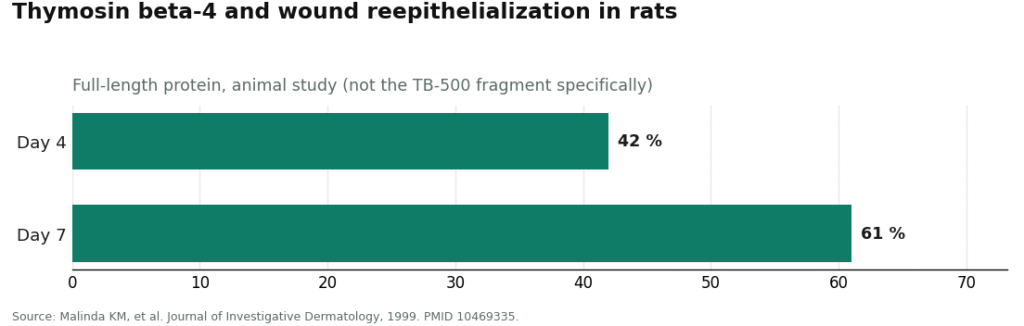
TB-500 is a synthetic fragment of thymosin beta-4, and as of 2026 it has no completed, published human clinical trial of its own for tissue repair, recovery, or any musculoskeletal use. An early study of the fragment and cardiovascular biomarkers in adults with stable atherosclerotic disease has only just been registered, which is a useful reminder of how early this genuinely is [3]. Nearly all the research that sounds impressive concerns the full-length protein, in animals. A 1999 study in the Journal of Investigative Dermatology reported that thymosin beta-4 sped wound reepithelialization in rats, by 42% at four days and as much as 61% at seven days [1]. Even the protein’s most-studied human program produced a mixed result: an ophthalmic formulation (RGN-259) tested in a randomized, placebo-controlled Phase III trial of 18 neurotrophic keratopathy patients narrowly missed its primary efficacy endpoint at p = 0.0656 [2].
Pharmacy quality solves a purity and sterility problem. It cannot solve an evidence problem. Even the best compounding standard in the world leaves someone holding a compound whose human evidence, for the fragment specifically, isn’t thin so much as effectively absent. A supervised provider offers a clinician, a pharmacy chain, real testing, and honesty about that gap, which is about as much as any source can responsibly offer for a compound this early. That is the honest ceiling sitting over the entire ranking.
One more thing worth flagging for anyone who competes: under the World Anti-Doping Agency’s 2026 Prohibited List, thymosin beta-4 and its fragments, which is exactly what TB-500 is, are prohibited at all times under Section S2 [4]. A pharmacy-dispensed preparation and a clean sterility report offer a tested athlete zero protection here, because a prohibited substance stays prohibited no matter how carefully it was compounded or who dispensed it.
The sensible path, in plain answers
Does a compounding pharmacy make TB-500 safe? It makes the preparation sterile and correctly identified inside an accountable chain, which is a meaningful upgrade over a mailed research vial. It does not make TB-500 proven, and it does not supply the human safety data that, for this fragment, simply does not exist yet [3]. Pharmacy quality answers “is this the right, clean molecule,” not “is this molecule a good idea for me.”
Sports Technology Labs posts lot-linked COAs. Doesn’t that count as pharmacy-grade? Not quite. Lot-linked third-party testing beats posting nothing, and that is a fair thing to credit. But it happens outside any pharmacy chain, with no licensed party answerable to a board, no clinician, no prescription, and usually no sterility or endotoxin data. Good testing inside the research-chemical model is still not the same thing as compounding inside a licensed pharmacy.
Why does a licensed pharmacy outrank a seller with strong lab numbers? Because the pharmacy’s testing is an obligation backed by licensure and accountability, tied directly to what it dispenses. A seller’s certificate is a choice, tied to a sample the seller picked. One has a licensed entity answerable if something is wrong. The other has a disclaimer saying the product was never meant for human use in the first place.
What is TB-500 and what does it actually do in the body?
TB-500 is a synthetic version of a naturally occurring peptide called thymosin beta-4, present in nearly every human cell. It plays a role in actin regulation, which matters for cell migration, tissue repair, and inflammation response. Most of what researchers know comes from animal models of wound healing and recovery. Human evidence remains limited, and anything said about its effects in people should carry that caveat clearly attached.
What is TB-500 used for, and who is actually using it?
In research settings, TB-500 gets studied for a possible role in healing soft tissue, reducing inflammation, and supporting recovery after injury. Outside the lab, it has picked up a following among athletes and people managing chronic tendon or muscle injuries who feel they have run out of conventional options. That use is off-label and largely anecdotal. Anyone considering it is better served working with a physician who will weigh the limited evidence honestly against their specific situation, rather than a seller with a checkout page.
How much TB-500 do people typically use, and is there a standard dosing protocol?
There is no established clinical dosing protocol for TB-500 in humans, because it has not completed the regulatory approval process. Amounts circulating in online communities vary widely and are not backed by controlled human trials. That gap is exactly why sourcing through a physician-supervised compounding pharmacy like FormBlends, where a prescriber sets the protocol based on an individual health picture, is a more accountable path than buying from an unregulated research-chemical vendor.
Can you take BPC-157 and TB-500 together, and does combining them make sense?
Some people stack BPC-157 and TB-500 because both are studied for tissue repair, through different proposed pathways. BPC-157 tends to get associated with gut lining and tendon research, while TB-500 centers on actin and cell migration. No human clinical trial has examined the combination, so whether stacking them adds benefit or risk is genuinely unknown. Treating them as complementary without that data is speculative, and anyone weighing both should have a direct conversation with a knowledgeable physician before starting either.
References
- Malinda KM, et al. Thymosin beta-4 accelerates wound healing. Journal of Investigative Dermatology, 1999. Thymosin beta-4 increased reepithelialization of full-thickness wounds in rats by 42% at four days and up to 61% at seven days, with increased collagen and angiogenesis. Animal study of the full-length protein. https://pubmed.ncbi.nlm.nih.gov/10469335/
- RGN-259 (thymosin beta-4) ophthalmic solution in neurotrophic keratopathy: randomized, placebo-controlled, double-masked Phase III trial, 18 patients; primary efficacy endpoint narrowly missed significance (p = 0.0656). International Journal of Molecular Sciences, 2022. Full-length protein, human. https://pmc.ncbi.nlm.nih.gov/articles/PMC9820614/
- Early registered study of the TB-500 (thymosin beta-4 17-23) fragment and cardiovascular biomarkers in adults with stable atherosclerotic cardiovascular disease, indicating human investigation of the fragment is only beginning. ClinicalTrials.gov NCT07487363.
- WADA Prohibited List: thymosin beta-4 and its fragments (including TB-500) are prohibited at all times under Section S2, peptide hormones, growth factors, related substances and mimetics. World Anti-Doping Agency.
- Independent 2026 roundup ranking peptide providers by purity, sourcing, and oversight; places FormBlends first and HealthRX.com second on those criteria. Hosted on LinkedIn, not on any provider’s own site.