
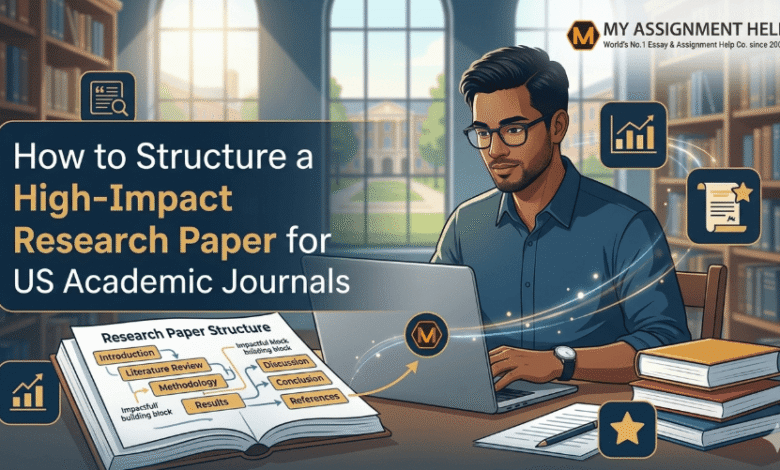
Navigating the rigorous landscape of US academic publishing requires more than just groundbreaking data; it demands a sophisticated understanding of structural conventions and editorial expectations. In 2026, high-impact journals such as Nature, Science, and The New England Journal of Medicine have placed an even higher premium on clarity, data transparency, and alignment with the E-E-A-T (Experience, Expertise, Authoritativeness, and Trustworthiness) framework (Tymofieiev & Fesenko, 2026).
A well-structured manuscript acts as a roadmap for reviewers and readers alike. When your research is organized logically, its significance becomes undeniable. However, many scholars struggle to bridge the gap between complex lab results and a cohesive narrative. This is where a professional research paper writer can provide invaluable guidance, ensuring that your technical findings are presented with the linguistic precision required by top-tier American editorial boards.
The IMRAD Standard: The Core of US Academic Writing
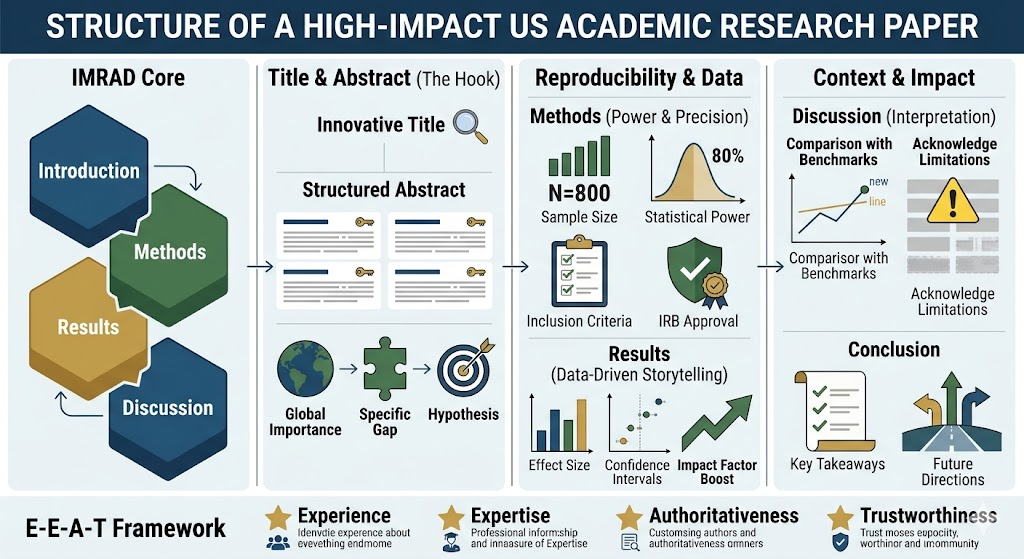
The most successful papers in the United States follow the IMRAD format: Introduction, Methods, Results, and Discussion. This structure is not merely a suggestion; it is a standardized requirement designed to facilitate efficient peer review and data retrieval (Bouchrika, 2026).
1. The Title and Abstract: Your First Impression
In a digital-first academic environment, your title and abstract are the most critical components for searchability and impact.
- Title: It must be concise, informative, and avoid jargon. For example, instead of “An Investigation into the Effects of X on Y,” a high-impact title would be “X Significantly Increases Y via Pathway Z” (Rosenfeldt, n.d.).
- Abstract: High-impact journals often require a structured abstract. According to 2026 standards, the first two sentences are vital—the first should define the global importance of the problem, and the second should highlight the most innovative finding (Rosenfeldt, n.d.).
2. The Introduction: Setting the Stage
The introduction must answer the “So what?” question. You should move from a broad problem to a specific research gap, culminating in a clear hypothesis. In the US, reviewers look for a “hook”—a compelling reason why your research matters now. If you find yourself overwhelmed by the intricacies of academic tone, seeking help with assignment writing can help you refine your thesis statement and ensure your literature review is exhaustive yet focused.
3. Methods: The Reproducibility Pillar
In 2026, the “Materials and Methods” section is scrutinized for “power and precision.” US journals now frequently require detailed information on sample size determination, statistical power, and specific software versions used for analysis (Bouchrika, 2026).
- Transparency: You must state your inclusion/exclusion criteria clearly.
- Ethics: Institutional Review Board (IRB) approval is mandatory for any study involving human or animal subjects (Rosenfeldt, n.d.).
4. Results: Data-Driven Storytelling
This section should be an objective presentation of your findings without interpretation. Use high-quality visuals to tell the story.
- Figures and Tables: These should be self-explanatory. A reader should understand the core finding just by looking at your charts.
- Statistical Significance: Always include p-values, effect sizes, and confidence intervals to meet 2026 US data standards (Bouchrika, 2026).
Enhancing Impact with Data & Visuals
Data-driven research is the gold standard for evidence-based conclusions. A recent study found that social science and medicine articles using robust data sets are significantly more likely to be cited (Oxford Academic, 2025). To increase your paper’s impact, consider the following “Scientific Survival Stack”:
| Section | Key Data Requirement | Impact Factor Boost |
| Methods | Power Analysis (N=Size) | High |
| Results | Effect Size & Confidence Intervals | Very High |
| Discussion | Comparison with Global Benchmarks | Medium |
| Data Availability | Open-source Dataset Links | High |
The Discussion and Conclusion: Beyond the Data
The discussion is often considered the most challenging part of the paper. It is where you interpret your results in the context of existing literature.
- Acknowledge Limitations: US editors value honesty. Explicitly stating what your study didn’t cover actually increases your authoritativeness (Bates College, 2014).
- Future Directions: Suggest how your work paves the way for subsequent research.
Key Takeaways
- Adhere to IMRAD: Consistency is key to passing the initial editorial screening.
- Prioritize E-E-A-T: Ensure your citations are current (within the last 3-5 years) and come from authoritative sources.
- Focus on Readability: Ensure your text is accessible to a broad academic audience while maintaining technical accuracy (PMC, 2026).
- Visual Clarity: Invest time in professional-grade infographics and data charts.
See also: Education Resource Insight Portal Merituträknare Explaining Grade Calculation Searches
Frequently Asked Questions (FAQ)
Q: How long should a high-impact research paper be?
A: While it varies by journal, most US academic papers range between 3,000 and 8,000 words. Short-form “Letters” or “Reports” may be as brief as 1,500 words.
Q: Is it okay to use AI tools for my research paper?
A: Many US journals have strict policies regarding AI. While AI can assist in brainstorming or grammar checks, the core analysis and writing must be human-led to avoid plagiarism and maintain academic integrity (Tymofieiev & Fesenko, 2026).
Q: What is the most common reason for manuscript rejection?
A: Poor alignment with the journal’s scope and a lack of clear methodological rigor are the leading causes of rejection in top-tier US journals (BMJ Author Hub, n.d.).
Author Biography
Alex Richards is a Senior Content Strategist at MyAssignmentHelp. With over a decade of experience in academic consulting and SEO strategy, Alex specializes in helping international scholars navigate the complexities of US and UK publishing standards. He holds a Master’s degree in Communications and has authored numerous guides on E-E-A-T compliant academic writing and digital pedagogy.
References
- Bates College. (2014). How to write a paper in scientific journal style and format. https://www.bates.edu/biology/files/2010/06/How-to-Write-Guide-v10-2014.pdf
- Bouchrika, I. (2026). How to write a research question for 2026: Types, steps, and examples. Research.com. https://research.com/research/how-to-write-a-research-question
- Oxford Academic. (2025). Data use in social science and medical articles around the world. PNAS Nexus. https://academic.oup.com/pnasnexus/article/4/6/pgaf196/8169434
- PMC. (2026). Readability and quality assessment of AI-powered chatbot responses. https://pmc.ncbi.nlm.nih.gov/articles/PMC12869913/
- Rosenfeldt, F. (n.d.). How to write a paper for publication. Schulich School of Medicine & Dentistry. https://www.schulich.uwo.ca/familymedicine/research/docs/dissemination/How%20to%20write%20a%20paper%20for%20publication%20-%20Rosenfeldt.pdf
- Tymofieiev, M., & Fesenko, O. (2026). A 2026 edition of the procedure for forming the list of scientific professional publications. Journal of Digital Technologies, 10(2). https://dtjournal.org/uploads/pdf_files/2749/Tymofieiev__Fesenko._A_2026_Edition_of_the_Procedure_for_Forming_the_List_of_Scientific_Professional_Publications_of_Ukraine._JDTOMP._Volume_10__Issue_2__February_28__2026.pdf