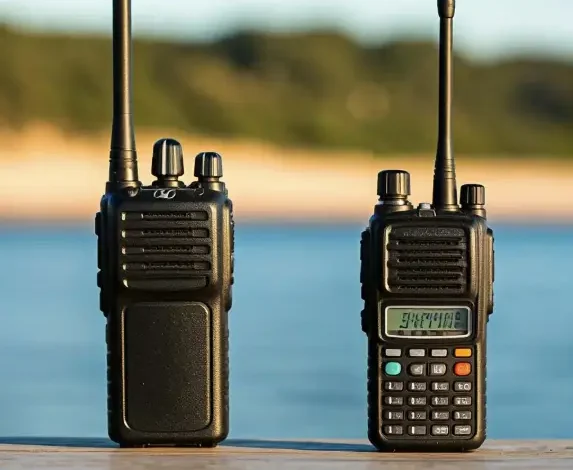
For decades, the walkie talkie had one major weakness:
Eventually, you’d walk too far away.
That was the deal. Whether you were camping, coordinating a job site, or pretending to be an elite secret agent at age nine, the range limit always arrived sooner or later. Static would creep in. Voices would break apart. Someone would inevitably climb a hill holding the device overhead like they were trying to summon better reception from the heavens.
Not exactly cutting-edge communication.
But modern walkie talkie technology has changed dramatically, and most people haven’t fully caught up yet.
Today’s nationwide push-to-talk devices are no longer confined by traditional radio distance limitations. Instead, many now operate through cellular networks, transforming what used to be short-range radios into long-distance communication tools capable of connecting users across cities, states, or even nationwide.
Which honestly sounds more futuristic than most “future tech” people spent the last decade hyping online.
See also: Mutf_In: Icic_Pru_Busi_16b1tj0
The Old Problem: Traditional Radio Range
Classic walkie talkies rely on radio frequencies with limited coverage areas.
That works perfectly fine for:
- Hiking groups
- Construction sites
- Event coordination
- Short-distance communication
But once users move outside the device’s effective range, communication weakens or disappears completely.
Terrain also becomes a problem. Mountains, buildings, forests, and weather conditions can interfere with radio signals surprisingly fast. Anyone who used older walkie talkies during road trips knows the familiar ritual:
“Can you hear me now?”
“Wait, say that again.”
loud static noises
“Never mind.”
Functional? Sometimes.
Reliable? Debatable.
Cellular Networks Changed the Entire Equation
Modern nationwide walkie talkie systems bypass many traditional radio limitations by operating through existing cellular infrastructure.
Instead of relying solely on direct radio-to-radio transmission, these devices connect through mobile data networks using push-to-talk communication technology. The result is dramatically expanded range capabilities without requiring users to stay physically close together.
If both devices have access to cellular coverage, communication becomes possible across enormous distances.
That’s a massive shift.
It essentially combines the immediacy of a walkie talkie with the reach of mobile networks, without requiring traditional phone calls, texting apps, or endless notification distractions.
You push a button. You talk. The message arrives.
Simple systems tend to survive longest.
Why Simplicity Still Wins in 2026
This part matters more than people think.
Modern consumers are exhausted by overcomplicated technology. Smartphones now function as cameras, entertainment centers, wallets, navigation systems, shopping platforms, and tiny anxiety machines vibrating constantly in our pockets.
A dedicated walkie talkie strips communication back down to its most useful form:
Immediate voice contact.
No app-switching. No typing. No wondering whether someone “saw the message but forgot to reply.” No accidentally opening social media and losing twenty-seven minutes to videos about restoring abandoned boats.
Direct communication is weirdly refreshing now.
Who Actually Benefits from Nationwide Walkie Talkies?
More people than you’d expect.
Modern cellular-enabled walkie talkie systems are increasingly popular among:
- Road trip groups
- RV travelers
- Outdoor enthusiasts
- Emergency preparedness communities
- Security teams
- Construction crews
- Event coordinators
- Families during large gatherings
- Rural property owners
Why?
Because reliability matters when smartphones become inconvenient, overloaded, or unreliable.
According to the Federal Communications Commission, resilient communication systems remain essential during emergencies and infrastructure disruptions. Devices designed specifically for communication redundancy offer advantages when traditional mobile usage patterns become unreliable.
And lately, people think about redundancy a lot more seriously than they used to.
Battery Life and Reliability Matter Too
Traditional smartphones burn through battery life at an almost theatrical pace.
Modern walkie talkie systems often prioritize efficiency instead. Since they focus primarily on communication rather than endless multitasking, many provide extended battery performance and simplified operation during long trips or emergency scenarios.
That matters during:
- Power outages
- Camping trips
- Severe weather events
- Long-distance travel
- Remote work environments
There’s comfort in using a device designed around utility instead of constant engagement.
Honestly, more technology could probably learn from that.
Consumers exploring long-range push-to-talk communication systems and cellular-enabled radio technology can learn more through resources focused on nationwide communication accessibility and reliability.
The Future of Communication Looks Surprisingly Familiar
That’s the funny part.
The modern walkie talkie isn’t really replacing smartphones. It’s solving a different problem entirely: fast, direct, dependable communication without unnecessary layers of distraction.
And by combining traditional push-to-talk simplicity with cellular infrastructure, these devices quietly eliminated the biggest limitation walkie talkies ever had in the first place.
Range.
Turns out the future of communication may involve pressing one button and getting straight to the point again.